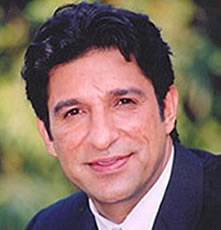
Waqar Younis Biography
Source(google.com.pk)
Waqar Younis, Cricketers is famous for Cricket, Pakistani celebrity. Born on 16 November, 1971
Waqar Younis Maitla is a former Pakistani right arm fast bowler in cricket and widely regarded as one of the best fast bowlers of all time.
He was best known in cricket for his ability to reverse swing a cricket ball at high speed when bowling at the cricket pitch. He took 373 Test wickets and 416 One Day International wickets during his career. He is considered to be the best exponent of the swing bowling delivery. Younis has the best strike rate for any bowler with over 200 Test wickets. He worked as a bowling coach with the national side from 2006 to 2007.
Younis was appointed as the coach of the Pakistan cricket team on 3 March 2010. His managerial contract with the Pakistan Cricket Board will take part in all forms of cricket, right up to December 2011, which will include all professional competitions, such as the 2011 Cricket World Cup.
Early and personal life
Younis was born in Vehari, Punjab in Pakistan in a Jatt family. He was educated in Sadiq Public School in Bahawalpur in Pakistan, the Pakistani College (Pakistan Islamia Higher Secondary School) in Sharjah and the Government College University in Vehari. He was raised in Sharjah in the United Arab Emirates, where his father was a contract worker. He returned to Pakistan during his adolescent years and there, he started playing cricket.
He is married to Dr. Faryal Waqar Younis with a son Azaan Waqar and a daughter Maira Waqar and now lives in Castle Hill in Australia. Younis has also worked as a television sports commentator for the Nine Network in Australia and for Ten Sports in the United Arab Emirates.
Cricket and coaching career
Younis began his cricket career in Pakistan, playing for several First-class cricket clubs. However he suffered an injury when he had cut and removed his little finger on his left hand, after he had jumped into a canal. He recovered from this accident and went on to continue his sporting career. He was eventually discovered by former Pakistan captain, Imran Khan and was selected to be part of the national side. The turning point of his career happened in England, during the late 1980s and early 1990s, when he played for Surrey County Cricket Club. There he displayed excellent cricketing performances and attracted attention from the sporting public.
He made his International cricket debut for Pakistan against India on 15 November 1989, in the same match that Indian batsman Sachin Tendulkar also made his debut. Younis took 4 wickets in the drawn match including the wickets of Tendulkar and Kapil Dev. He made an immediate impression with his speed and became known in the cricket media as "Wiki" or the "Burewala Express". Younis along with Wasim Akram opened the bowling attack regularly for Pakistan, becoming a feared and potent attack. His most recognized delivery was an inswinging yorker. At his peak, he developed into a very quick fast bowler and also became famous for achieving a hat-trick in a One Day International match against New Zealand in 1994. He won the English County Championship with Glamorgan in 1997. During the early periods of 2000, he stayed out of the Pakistan team for a brief period allegedly due to suspension and conflicts with bowling partner and captain Wasim Akram. His return to cricket came with him being appointed the captain of Pakistan, a position he held until his team failed to make an impact in the 2003 Cricket World Cup. He retired from cricket in 2003 after the Pakistan Cricket Board persistently ignored him for national selection.
In March 2006, he was appointed as the bowling coach for Pakistan. He resigned from this position on 6 January 2007 in protest against the Pakistan Cricket Board decision to retain him only for the Test series against South Africa and not for the subsequent series of five One Day International matches. He was re-appointed as Pakistan's bowling and fielding coach for their tour of Australia in December 2009. In February 2010, Younis was appointed the head coach of Pakistan after Intikhab Alam was sacked as coach, due to the low-level of performances of the national side during the tour of Australia earlier that year.
Waqar's first job as coach was to lead an inexperienced Pakistan side missing Younis Khan, Mohammad Yousuf and Shoaib Malik to the 2010 ICC World Twenty20 as a consolation though Waqar had two top-notch bowlers in Mohammad Amir and Mohammad Asif at his disposal. He guided the defending champions to the semi-final of the tournament before the were knocked out by Australia courtesy of a superb 60* by Mike Hussey who whacked three sixes in the final over to seal the victory.
The World Twenty20 was followed with the 2010 Asia Cup in which Pakistan lost to Sri Lanka by a narrow-margin as Pakistan's top order collapsed and it was Shahid Afridi who scored 112 to nearly guide Pakistan to victory. In the following match Pakistan lost narrowly against India courtesy of a six by Harbhajan Singh an the third ball of the final over. The following match was a dead rubber between Pakistan and Bangladesh and another Afridi century meant Pakistan scored 385 runs and they comfortably won the match by 139 runs
After this a tour of England followed with two Twenty20's against Australia and two Test matches. Pakistan won both Twenty20's comfortably and the first test saw Pakistan defeated by 154 runs. Pakistan rallied in the second test and for the first time in 15 years Pakistan defeated Australia in a Test match. Ironically the previous victory in 1995 was also courtesy of a superb bowling spell by Waqar Younis
This tour was followed by a controversial tour against England as Pakistan headed in to the final Test match needing to win it to level the series 2-2 the News of the World broke a story that Mohammad Amir, Mohammad Asif and captain Salman Butt were involved in Spot-fixing. This saw the three players temporarily suspended and Pakistan lost by an innings and 225 runs their biggest defeat in history. Low team-morale meant the next two T20 matches were won comfortably by England. Following an ODI series which Pakistan lost 3-2.
This was followed by a tour of Abu Dhabi playing against South Africa Pakistan lost the first Twenty20 match by six-wickets following a batting-collapse which meant that no partnerships were formed. Pakistan also lost the ODI series of five matches by 3-2. Pakistan won the second one day due to Abdul Razzaq's superb performance scoring 109* off 72 ball. The test series of two matches with South Africa was drawn. He also stated that now it was the time for Pakistan to rally and prepare for the World Cup
Skills in cricket
Younis is one of several Pakistani fast bowlers, beginning with Sarfraz Nawaz, who have been successful at bowling reverse swing. In partnership with Akram, Younis opened the Pakistan bowling attack in the 1990s. Cricket critics and scholars attribute Younis and Akram to be one of the most effective fast bowling partnerships in cricket, due to their ability to swing the ball at high speed. The ability to reverse swing and his speed led to him becoming one of the most talented bowlers in modern cricket.
Younis explained his ability to reverse swing by the manipulation of an old ball; with one side shiny, one side rough, the ball would move in the opposite direction to conventional swing. This led to Younis having the ability to bowl inswingers and outswingers in the cricket pitch and in effect both Younis and Akram became successful in taking wickets by this variation of swing bowling. His fastest delivery in cricket was 153 km/h or 95.1 mph, a delivery he bowled against South Africa in 1993. He was also effective in the use of bouncers or short pitch deliveries; Younis' bowling against South Africa in Sheikhupura in Pakistan, is remembered for his effective use of the short pitched delivery.
Following Pakistan's victory during the Test match series versus England in 1992, the English media were suspicious of the reverse swing delivery. It was relatively unknown to the cricketing world during that period and this led to accusations of foul play by critics, however cricket officials found no evidence of foul play and the skill of the reverse swing delivery has been accepted in cricket.
Sri Lanka fast bowler, Lasith Malinga, who became the first bowler in World Cup history to take two hat-tricks, has said that he learnt to bowl his deadly yorkers by watching Pakistan's legendary pair of Wasim Akram and Waqar Younis. No doubt over the years several bowlers have learned and mastered the skill of reverse swing but there are still some techniques which haven't have been explored e.g. banana swing. Title of Banana swing bowler was given to Waqar Younis because of his unique technique of swinging the ball in the air at very high speed before hitting the ground. In most of his hat tricks he has delivered banana swing balls which were unplayable.
Despite his qualities as a fast bowler, he was expensive at times and sometimes lacked the consistency of bowlers such as West Indian fast bowler Curtly Ambrose and Australian fast bowler Glenn McGrath. This may be partly due to the mentality of his former captain, Imran Khan, who prioritised aggression and speed.
Award and records
See also: List of international cricket five-wicket hauls by Waqar Younis
Younis was awarded Wisden Cricketers of the Year in 1992 for his sporting achievements. He is also the only bowler to have taken a 5 wickets in an innings in 3 consecutive One Day International matches. He has taken a 5 wicket hauls on 13 occasions in One Day International matches. In terms of deliveries bowled, he has taken the fastest 50, 300, 350 and 400 wickets in One Day International matches and the fastest 150, 200, 250, 300 and 350 wickets in Test matches.
Although primarily a fast bowler, Younis scored 1010 Test match runs during his career. As of September 2005, he was the only non-batsman to achieve a thousand runs without scoring a fifty.
Younis holds the record for the best strike rate for any bowler with over 200 Test wickets.
Cricket controversies
In July 2000 Younis became the first cricketer to be banned for ball tampering and was fined 50% of his match fee.
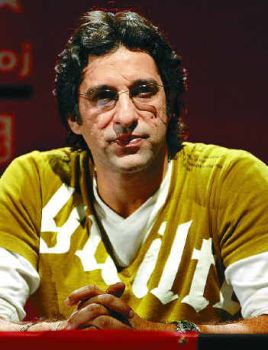
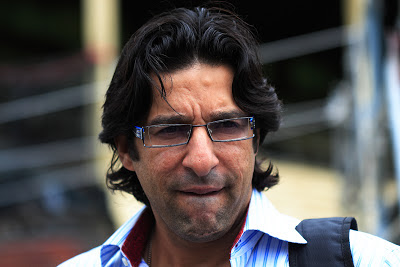
Waqar Younis
Waqar Younis
Waqar Younis
Waqar Younis
Waqar Younis
Waqar Younis
Waqar Younis
Waqar Younis
Waqar Younis
Waqar Younis
Waqar Younis








.jpg)